When Should You Select Plumbing Fixtures for a Custom Home?
Written by Susie Marion
Plumbing fixtures are often thought of as finishing touches—the beautiful faucet, sculptural tub, or shower system that completes a bathroom or kitchen. In a custom home, however, many of these decisions affect construction long before the finished fixtures arrive.
The selections can influence plumbing locations, valve requirements, cabinetry, countertop openings, wall depths, tile layouts, electrical needs, and installation clearances. Waiting too long may limit the available choices or require the builder and trades to revisit work that has already been planned.
For that reason, we treat plumbing fixtures as part of the architectural and fixed-finish design rather than as isolated decorative purchases. The goal is to make every fixture feel appropriate to the room while giving the architect, builder, fabricator, and plumber the information they need at the right time.
When should plumbing fixtures be selected for a new custom home?
The short answer is: earlier than most homeowners expect.
The precise schedule belongs to the builder, but the design direction and fixture specifications should generally be developed before the relevant plumbing rough-ins are finalized. A fixture’s installation requirements may affect where supply lines, drains, valves, blocking, outlets, and controls belong.
We begin by understanding how each room needs to function. A primary bathroom planned for two people may need a very different fixture arrangement from a powder room, children’s bathroom, utility space, or outdoor kitchen.
Before selections are finalized, we consider:
Who will use the room
Whether two people need to use it at the same time
The desired water experience and controls
Accessibility and ease of operation
Cleaning and maintenance preferences
Cabinetry and countertop dimensions
Tile thickness and wall construction
Available plumbing locations
The home’s water-heating plan
The builder’s construction schedule
The homeowner’s priorities and budget
The visible design matters, but it is only one part of the decision. A faucet that looks perfect in a photograph still has to work with the selected sink, countertop, cabinet, backsplash, and plumbing configuration.
Which fixtures need to be coordinated before rough plumbing?
The plumber determines the exact installation sequence, but many homeowner-facing selections must be known early enough for the rough plumbing to support them correctly.
These may include:
Tub type, size, filler, drain, and overflow
Shower valves, controls, heads, hand showers, and body sprays
Wall-mounted, deck-mounted, or widespread faucets
Sink type and dimensions
Toilet location and model requirements
Pot fillers
Kitchen, bar, prep, and utility sinks
Refrigerator or appliance water connections
Outdoor kitchen and pool-bath fixtures
Floor drains or specialty drains
Steam-shower equipment
Bidet seats or integrated bidet toilets
A wall-mounted faucet, for example, requires a different approach from a faucet mounted through a countertop. A freestanding tub filler needs careful placement relative to the tub, floor structure, surrounding circulation, and finished flooring. A shower system may require specific valves and adequate wall depth.
This does not mean every decorative detail must be installed early. It means the construction team needs complete and accurate specifications before the hidden work is closed in.
Who makes the best-quality plumbing fixtures?
There is no single manufacturer that is best for every room, budget, style, and technical requirement.
Quality should be evaluated at the product and system level. We look beyond the finish color and consider the construction, valve compatibility, available replacement parts, warranty, lead time, service support, installation requirements, and whether the collection includes everything the room needs.
A manufacturer may offer an excellent kitchen faucet but not the right shower configuration for a particular bathroom. Another may have beautiful designs but a lead time that does not work with the construction schedule.
When comparing options, we ask:
Is the required rough-in or valve readily available?
Are all necessary components clearly specified?
Does the finish remain consistent across the collection?
Are replacement cartridges and parts obtainable?
Is there reliable technical and warranty support?
Does the fixture meet the room’s functional needs?
Does its scale suit the sink, tub, or shower?
Can it be installed within the planned construction?
Is its lead time compatible with the schedule?
Does the investment make sense within the overall design budget?
We also review samples when the exact finish matters. Names such as brass, bronze, nickel, and black can describe very different colors and sheens from one manufacturer to another.
The best-quality choice is the one that combines appearance, function, technical compatibility, serviceability, and appropriate value for that particular room.
Do all the plumbing fixtures in a house need to match?
No. A home should feel cohesive, but every fixture does not need to come from the same collection or even use the same finish.
Consistency is most important within a single visual area. In a bathroom, the sink faucet, tub fittings, shower controls, accessories, mirrors, lighting, cabinetry hardware, and nearby architectural metals should be considered together.
Across the house, we may repeat a finish to create continuity, vary it intentionally by room, or use a limited family of complementary finishes. A powder room can have a more distinctive personality than a secondary bathroom while still belonging to the same home.
We pay attention to:
The undertones of each metal
Polished, brushed, satin, or living finishes
The shape and visual weight of the fixtures
Traditional, transitional, or contemporary detailing
Nearby hardware and lighting
The color of the stone, tile, cabinetry, and paint
What can be seen from adjacent rooms
Cohesion comes from a clear design language, not from repeating one exact faucet everywhere.
Can plumbing fixtures be changed after rough-in?
Sometimes, but the answer depends on what is changing.
A new trim style may be possible when it is compatible with the valve already installed behind the wall. A different mounting type, valve system, tub configuration, or fixture size may require more significant changes.
That is why we do not approve a fixture based on appearance alone. The model numbers for the visible trim, hidden valves, drains, accessories, and other required components need to be coordinated as a complete specification.
When a selection changes, the design and construction teams should review:
Valve compatibility
Supply and drain locations
Required wall or floor depth
Cabinet and countertop openings
Stone and tile penetrations
Waterproofing implications
Electrical requirements
Lead time and availability
Cost and schedule effects
Changes are a normal part of some custom projects. Clear communication allows the team to determine whether a change is simple, possible with adjustments, or better avoided.
Who installs plumbing fixtures in a custom home?
A qualified plumber typically installs plumbing fixtures and their required components. The builder coordinates that work within the larger construction schedule and confirms the appropriate licensed trade for the project.
The interior designer’s role is different but closely connected. We develop the visual and functional direction, specify the products, coordinate them with the other materials, and communicate the necessary information to the homeowner and project team.
For a new construction interior designer in Austin, successful fixture planning means collaborating with:
The homeowner
Architect
Builder
Plumber
Cabinetry team
Countertop fabricator
Tile installer
Electrician
Lighting designer or supplier
Appliance team
Each participant sees the project from a different perspective. The designer helps keep the homeowner’s intended experience and the overall visual composition at the center of those technical conversations.
How should plumbing-fixture finishes relate to lighting and hardware?
Metal finishes are most successful when they are reviewed as part of the entire room.
We compare plumbing fixtures with cabinet hardware, decorative lighting, mirror frames, shower enclosures, door hardware, towel bars, and other visible metal details. The finishes do not always have to match, but their undertones and levels of sheen should feel intentional.
Mixing metals can add depth when there is a clear hierarchy. One finish might lead on the plumbing while another appears in the lighting or hardware. Repetition helps the combination feel deliberate rather than accidental.
Samples are especially useful because online images can shift the apparent color. A warm brass fixture may look very different beside a cool gray stone than it does on a screen.
What plumbing-fixture details are easy to overlook?
The smallest components can create the largest delays when they are missing from a specification.
Before ordering, the team may need to confirm:
Rough-in valves
Trim kits
Drains and overflow assemblies
Sink strainers
Supply lines
Mounting hardware
Escutcheons
Hand-shower brackets and hoses
Tub-filler placement
Toilet accessories
Disposal or filtration compatibility
Required electrical connections
Finish availability across all components
Delivery dates and inspection procedures
It is also important to know which items ship together and which must be ordered separately. A fixture photograph may show a complete installation even when several essential components are not included in the base price.
How does Marion Interior Design coordinate plumbing selections?
At Marion Interior Design, plumbing fixtures are developed alongside the cabinetry, countertops, tile, lighting, paint, and architectural details. We want the visible elements to feel composed while the specifications support the realities of construction.
Our process is collaborative. We present refined options, discuss the differences that matter, document approved selections, and coordinate with the architect, builder, and relevant trades.
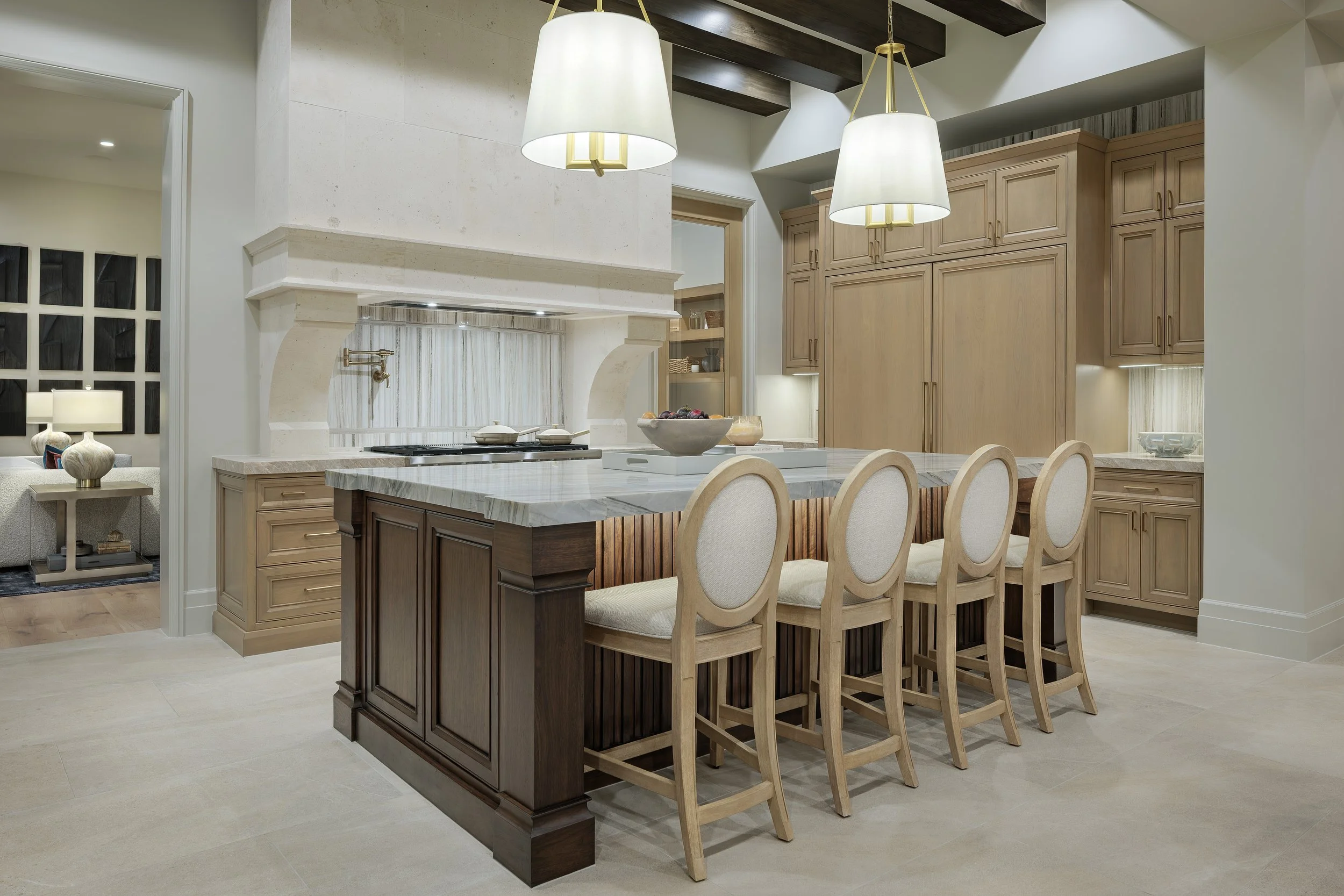
For Westlake Lane, Marion Interior Design developed the fixed interior finishes and furnishings as one complete vision. That whole-home approach is valuable because a plumbing fixture is never seen alone—it is experienced with the stone, cabinetry, lighting, hardware, and proportions surrounding it.
A full-service interior designer in Austin can help homeowners make these interconnected decisions before the project reaches the point where choices become restricted or changes become more disruptive.
The best fixture plan is both beautiful and buildable
Plumbing selections should express the character of the home, feel comfortable to use, and give the construction team the information required to execute the design correctly.
When fixtures are selected as part of a coordinated design plan, the homeowner does not have to make each decision in isolation. The result is a home in which the visible finishes, hidden requirements, and daily experience support one another.