Can an Interior Designer Work With Your Existing Furniture?
Written by Susie Marion
Hiring an interior designer does not mean every piece you own must disappear.
Many of the most personal homes include furniture, art, antiques, and objects collected over years. Some pieces have financial value. Others are meaningful because they belonged to a family member, were discovered while traveling, or have simply become part of the homeowner’s daily life.
The goal of a thoughtful furnishing plan is not to replace everything for the sake of creating something new. It is to determine which existing pieces support the home’s architecture, function, and desired atmosphere—and then develop the surrounding design with intention.
At Marion Interior Design, we begin by reviewing what the homeowner already owns. We consider what should remain as it is, what might benefit from updating, what could work better in another room, and where a new piece would create a meaningful improvement.
Can an interior designer use furniture you already own?
Absolutely.
Existing furniture can provide history and individuality that cannot always be purchased new. A room often feels more collected and less like a showroom when selected older pieces are thoughtfully combined with new furnishings.
The important word is “selected.” Keeping every piece automatically can restrict the floor plan and make it difficult to achieve the scale, comfort, or clarity the new home needs. Removing everything automatically can erase part of the homeowner’s story.
We evaluate each piece individually and in relation to the complete home.
We consider:
Its dimensions and visual scale
Structural condition
Comfort
Material quality
Sentimental or financial value
How frequently it is used
Whether it suits the architecture
How it relates to the desired design direction
Whether it can be repaired, refinished, or reupholstered
Whether another room would be a better location
The cost of updating it compared with replacing it
Delivery access and installation requirements
A piece does not have to match the new design perfectly at the beginning. It needs to offer something worth building around.
How do you decide which furniture to keep?
We start with an inventory and a floor plan.
Photographs are helpful, but accurate dimensions are essential. A sofa that worked beautifully in one house may be too small for a larger living room, too deep for a narrower space, or incompatible with the new room’s circulation.
Before assigning an existing piece to the plan, we ask:
Does it physically fit?
Does it support the room’s function?
Is it comfortable and in usable condition?
Is its quality worth preserving?
Does it have personal meaning?
Can it relate to the new design?
Would updating it be a good use of the furnishing budget?
Is there a better location for it elsewhere in the home?
The most valuable piece is not always the most expensive one. A modest inherited chair might become an important accent because of its history, while a costly sectional may not suit the proportions or function of the new living room.
These decisions are easier when they are made early, before new furniture is selected or ordered.
Should sentimental furniture always be kept?
Sentimental importance deserves respect, but keeping a piece does not necessarily mean placing it in the most prominent room.
We first identify why the piece matters. Is it associated with a particular person or memory? Is its craftsmanship significant? Is the homeowner attached to the entire object, or could part of it be preserved in another way?
A sentimental item might be:
Used in its original condition
Repaired or professionally restored
Refinished to relate to the new palette
Reupholstered in a more suitable textile
Moved to a quieter, more personal room
Repurposed for a different function
Displayed as an accent rather than used daily
Documented and passed to another family member
Not every family piece needs to become the focal point of a principal room. The most thoughtful placement is one that honors its meaning without asking it to perform a role it cannot fulfill.
How do you mix old and new furniture without making a room look mismatched?
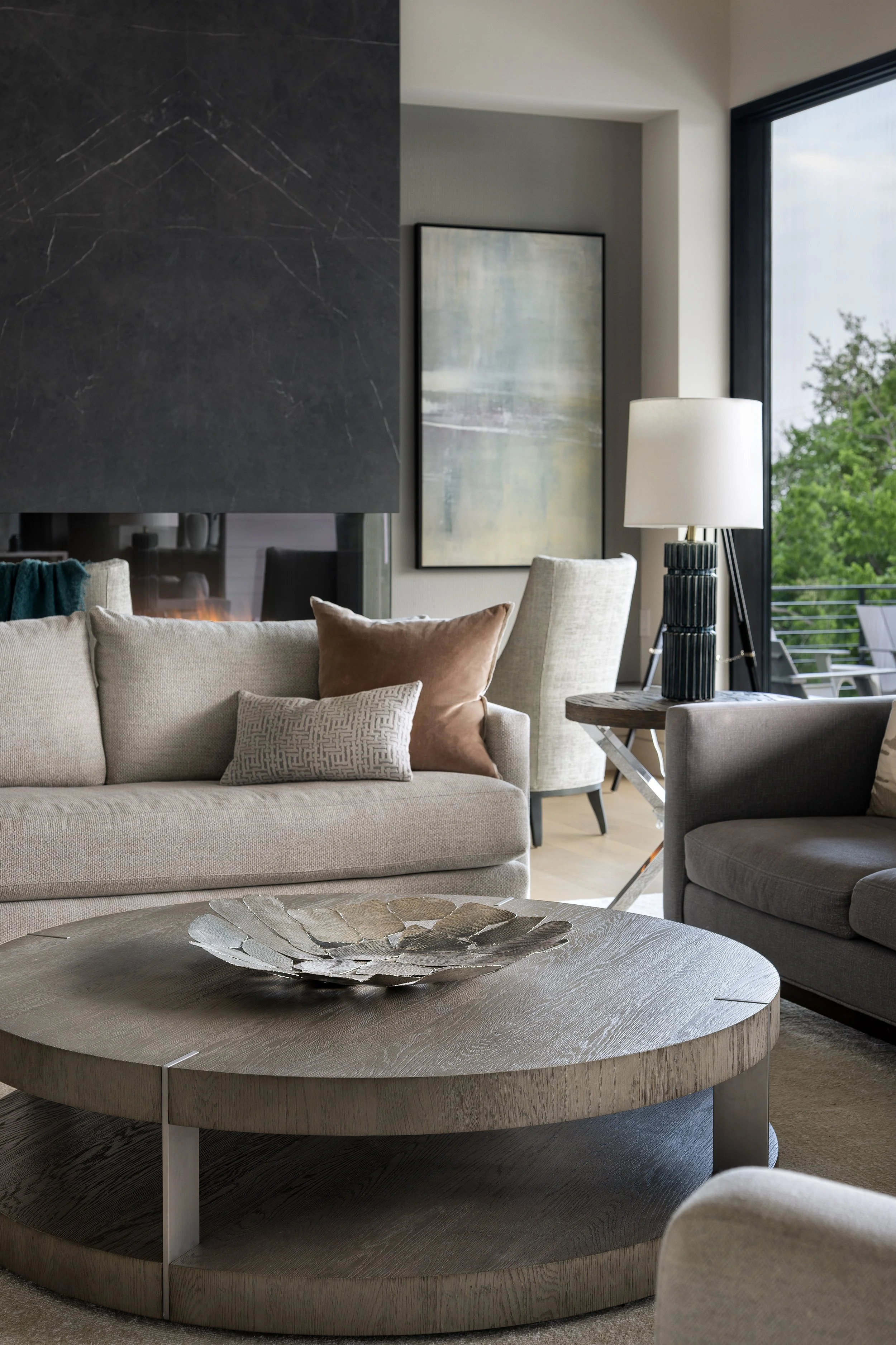
Successful rooms do not require every piece to come from the same period, collection, or manufacturer.
In fact, furnishing an entire room from one matching group can make it feel impersonal. Mixing eras creates depth, but the pieces still need visual relationships.
We use several elements to create cohesion:
Scale and proportion
A delicate antique table may be beautiful, but it can look stranded beside oversized upholstered furniture. Conversely, a heavy cabinet may overwhelm a room of visually lighter pieces. We study height, width, mass, and negative space so the room feels balanced.
Repeated materials
Wood tones do not have to match exactly, but repetition helps. A warm wood on an existing chest might be echoed in a new chair frame, decorative box, or picture frame. The same is true of metals, stone, leather, and woven materials.
Color
A new upholstery fabric can connect an existing piece to the room’s rug, drapery, art, or wall color. The relationship can be subtle; it does not need to be an exact match.
Shape and line
A curved antique chair can relate to a contemporary table through a shared softness of form. A rectilinear vintage cabinet may work with modern architecture when other pieces repeat its strong geometry.
Visual hierarchy
Not every item should compete for attention. We decide which piece is the focal point and allow the remaining furnishings to support it.
The objective is not to disguise the age of an older piece. It is to give the contrast a clear purpose.
Can old furniture be updated?
Often, but the work should be evaluated carefully.
Reupholstery, refinishing, repair, new hardware, or interior modifications can extend the life of a worthwhile piece. These services also involve skilled labor, materials, transportation, and time, so updating an item is not automatically less expensive than buying something new.
A strong candidate for restoration or reupholstery usually has:
A well-constructed frame
Appropriate dimensions
Good proportions
Useful function
Material or craftsmanship worth preserving
Personal importance
A realistic scope of repair
A finished value that supports the investment
For upholstery, we may evaluate the frame, springs or suspension, cushions, padding, and amount of required fabric. A new textile alone cannot correct an uncomfortable frame or proportions that do not fit the room.
For wood furniture, we consider whether the existing finish can be repaired, stripped, stained, painted, or preserved. Natural variation and evidence of age may be part of the piece’s beauty rather than something to eliminate.
Can existing furniture be used in a new custom home?
Yes, but it should be considered while the furnishing plan and, when possible, the architecture are still being developed.
A large inherited cabinet may need an appropriately proportioned wall. An existing dining table affects the number and scale of chairs, chandelier placement, rug dimensions, and circulation. A piano influences space planning, acoustics, humidity considerations, and nearby furnishings.
When these items are discussed early, we can account for them instead of trying to fit them into leftover spaces.
A whole-home interior design process allows the architecture and furnishings to inform one another. This may affect:
Wall dimensions
Door and hallway clearances
Electrical and lighting locations
Floor outlets
Built-ins
Art lighting
Window-treatment placement
Furniture layouts
Delivery access
Storage planning
The earlier an important piece is identified, the more naturally it can be integrated.
What if the existing furniture does not fit the new home?
Sometimes a loved piece is simply wrong for its intended location.
It may be too large, too small, uncomfortable, damaged, or incompatible with the way the new room needs to function. This does not make the piece bad; it means the context has changed.
We may explore:
Moving it to another room
Using it in a second home
Giving it to a family member
Placing it in storage temporarily
Selling it through an appropriate resource
Donating it
Retaining a smaller related piece instead
Photographing or documenting it before letting it go
These choices can be emotional. A clear floor plan helps because it replaces a vague opinion with practical information. Homeowners can see whether the piece fits and what must be compromised to accommodate it.
How do you furnish around an important work of art or antique?
An important piece can become the foundation of the room rather than an obstacle.
We begin by identifying what makes it distinctive: color, material, scale, history, silhouette, texture, or craftsmanship. We then determine how much visual emphasis it should receive.
The surrounding furnishings do not need to imitate the piece’s period. A traditional painting can feel striking above a clean-lined console. An antique chest can add warmth to a contemporary room. A sculptural modern chair can bring energy to more classical architecture.
Lighting, wall color, placement, and negative space are especially important. An object with presence needs enough room to be appreciated.
We want the room to feel collected over time—even when many of its elements were selected through one coordinated furnishing process.
Do you have to keep furniture simply because it was expensive?
No. The amount originally paid should not be the only factor.
A high-quality piece may deserve a new location, new upholstery, or restoration. But if it is uncomfortable, improperly scaled, or functionally wrong for the home, keeping it in a principal room may create a larger design problem.
We consider its present usefulness and value, not only its purchase history.
In some cases, using the piece elsewhere preserves the investment. In others, selling or consigning it may allow part of its value to be redirected toward something more appropriate.
The goal is to avoid designing an entire room around a piece the homeowner no longer enjoys merely because letting it go feels wasteful.
When should new furniture be selected?
New furnishings should be selected after the existing inventory has been reviewed and the floor plans have been developed.
This prevents duplicate purchases and helps focus the budget where it will have the greatest impact.
New pieces may be needed to:
Establish the correct scale
Improve comfort
Complete a seating group
Provide necessary storage
Respond to the architecture
Add durability for family life
Introduce color or texture
Balance an older piece
Support entertaining
Fill a functional gap
Create a focal point
At Marion Interior Design, furnishings are coordinated with rugs, drapery, art, accessories, plants, bedding, and other finishing layers. Through our full-service design process, we also manage purchasing, receiving, inspection, storage, delivery, and installation.
The homeowner does not have to assemble the finished home one isolated purchase at a time.
Can a turnkey interior feel personal?
It should.
Turnkey interior design does not mean removing the homeowner’s history or creating a house that feels staged for someone else. It means coordinating the many decisions and logistical details required to deliver a complete home.
Marion Interior Design’s published client experience includes a whole-home project in which existing pieces were integrated into the finished design and made to feel renewed. That is an important part of luxury home furnishing: learning what the homeowner values, preserving the pieces that matter, and creating the right context for them.
A completed home can include new custom furnishings, trade pieces, antiques, existing furniture, commissioned art, family objects, and practical everyday items. What makes it cohesive is the plan connecting them.
A personal home is developed, not replaced
The best furnishing plans balance editing with preservation.
Some existing pieces deserve to remain exactly as they are. Others may need a new fabric, finish, function, or location. Some have completed their role and can be released. New furnishings then fill the remaining needs with the correct scale, comfort, quality, and character.
The result should not feel old or new. It should feel like the homeowner—refined through thoughtful planning and ready for the way they live now.