Should You Choose Shades, Drapery, or Both for a Custom Home?
Written by Susie MarionWindow treatments are often considered toward the end of a project, but the best results begin much earlier.
Shades and drapery affect privacy, light control, glare, acoustics, furniture placement, and the way a room feels. They may also require recessed ceiling pockets, blocking, electrical wiring, home-automation coordination, and precise measurements.
For a custom home, window treatments should be planned as part of the architecture and furnishings—not treated as an accessory added after move-in.
These are three of the questions we consider when creating a whole-home window-treatment plan.
Should you choose shades or drapery?
The answer depends on what the room needs to accomplish.
Shades are often the most practical solution for privacy, glare reduction, and everyday light control. Depending on the fabric and construction, they can filter harsh sunlight, provide room darkening, or disappear quietly when raised.
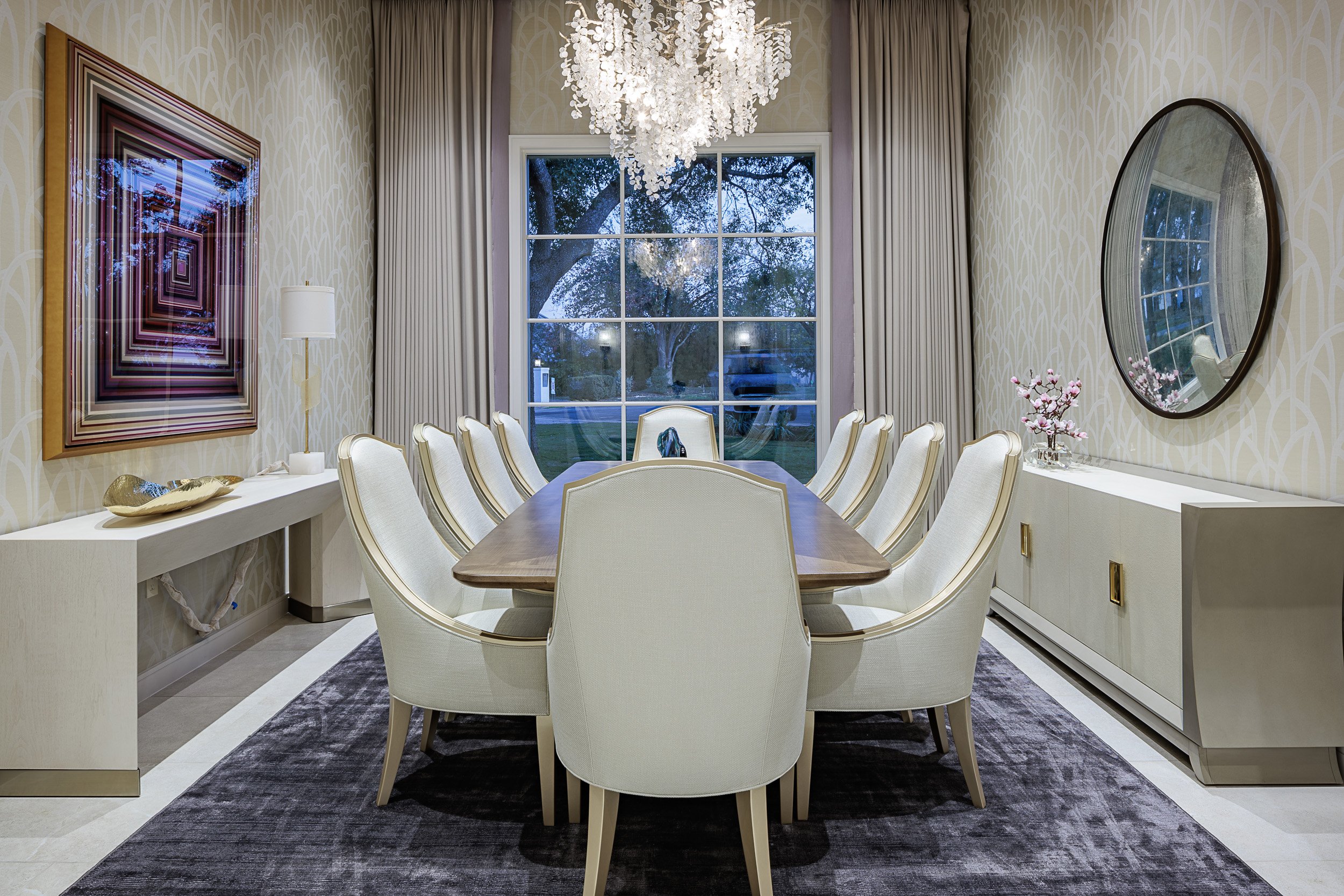
Drapery adds softness, movement, visual height, and a more finished architectural presence. It can make a large room feel more comfortable, soften hard surfaces, and create a strong relationship between the windows and furnishings.
Many rooms benefit from both.
A layered treatment might combine a functional shade with decorative drapery. The shade manages privacy and sunlight, while the drapery adds softness, color, pattern, or texture. In bedrooms, a shade can provide room darkening while drapery completes the composition and softens the architecture.
We consider several factors before recommending a treatment:
The room’s privacy requirements
Window orientation and direct sunlight
Desired light filtering or room darkening
Window height and width
Available wall space beside the window
Furniture and artwork placement
Architectural style
Ceiling details and drapery pockets
Fabric performance and maintenance
Whether the treatment will be manually operated or motorized
There is no rule that every window requires drapery. Some architectural windows are better served by quiet shades that preserve the view. Other rooms feel unfinished without the scale and softness of full-height fabric.
The treatment should support the window rather than simply cover it.
When should window treatments be planned for a custom home?
Window treatments should be considered while the architectural and electrical plans are still being developed.
At Marion Interior Design, early drapery planning can include coordinating recessed pockets for concealed tracks, blocking requirements, and electrical locations for motorized treatments. These details need to be communicated before framing, drywall, and ceiling finishes make changes more difficult.
The overall design can then be refined alongside the furnishings. Once furniture layouts, wall finishes, and room palettes are established, we can select the specific fabrics, trims, hardware, and treatment styles.
This sequence is important because window treatments relate to much more than the windows. They may affect:
Bed and nightstand placement
The width of a sofa or console
Artwork locations
Floor and wall outlets
Sconces and lighting controls
Millwork beside a window
Ceiling beams or crown molding
Upholstery and rug selections
Home-automation programming
Final measurements should be taken by the window-treatment professional after the relevant construction conditions are sufficiently complete. Even detailed architectural plans cannot replace verified field measurements for custom fabrication.
Planning early does not mean ordering prematurely. It means creating the necessary architectural conditions first, developing the design in the correct sequence, and placing the final order when dimensions and specifications can be confirmed.
Are motorized shades worth including?
Motorized shades can be particularly valuable in a large custom home, but they should be selected according to how the homeowners actually live.
Motorization may be useful for:
Tall or difficult-to-reach windows
Large groups of windows
Primary bedrooms
Media rooms
Rooms with strong afternoon sun
Spaces where several shades should operate together
Homeowners who want scheduled privacy or light control
Treatments integrated with a whole-home automation system
Motorized treatments are most successful when the designer, window-treatment vendor, builder, electrician, and home-automation professional coordinate early.
The team needs to confirm the appropriate power source, wiring location, motor compatibility, pocket dimensions, controls, and integration requirements. Waiting until the treatment is ready to order can limit the available options or result in visible wiring that could have been concealed.
Motorization should make the home easier to use. A complicated system that homeowners do not understand is not an improvement. Controls should be intuitive, and frequently used treatments should remain simple to operate.
We also consider whether every shade truly needs automation. It may be more appropriate to prioritize large, high, or frequently adjusted windows while using manual treatments in secondary spaces.
Should window treatments match throughout the house?
Window treatments should feel coordinated, but they do not need to be identical.
A whole-home plan might establish a consistent shade style or lining standard, then allow drapery fabrics and details to respond to individual rooms. The primary bedroom may call for a softer or more layered treatment than the kitchen. A formal room may support a more detailed composition, while a contemporary living space benefits from a quieter treatment.
Continuity can come from:
Related neutral tones
Consistent lining colors
Repeated hardware finishes
Similar pleat or heading styles
Consistent mounting heights
A shared level of formality
Fabrics coordinated with the whole-home palette
Consistency is especially important where several rooms can be seen at once. Treatments do not have to match, but the changes should feel intentional.
The exterior appearance also deserves consideration. Lining colors and shade backings should be reviewed so the home presents a cohesive appearance from outside.
Why plan window treatments as part of the whole home?
Window treatments influence how a room looks throughout the day. They frame views, control sunlight, protect privacy, soften acoustics, and complete the relationship between architecture and furnishings.
When they are planned early, the necessary pockets, wiring, and blocking can be incorporated discreetly. When they are designed with the furniture and finishes, the rooms feel cohesive. When their fabrication and installation are professionally coordinated, the final result feels intentional rather than added later.
For homeowners considering whole-home interior design in Austin or Central Texas, window treatments deserve the same level of planning as lighting, cabinetry, furniture, and art. They are both functional equipment and an important finishing layer of the home.