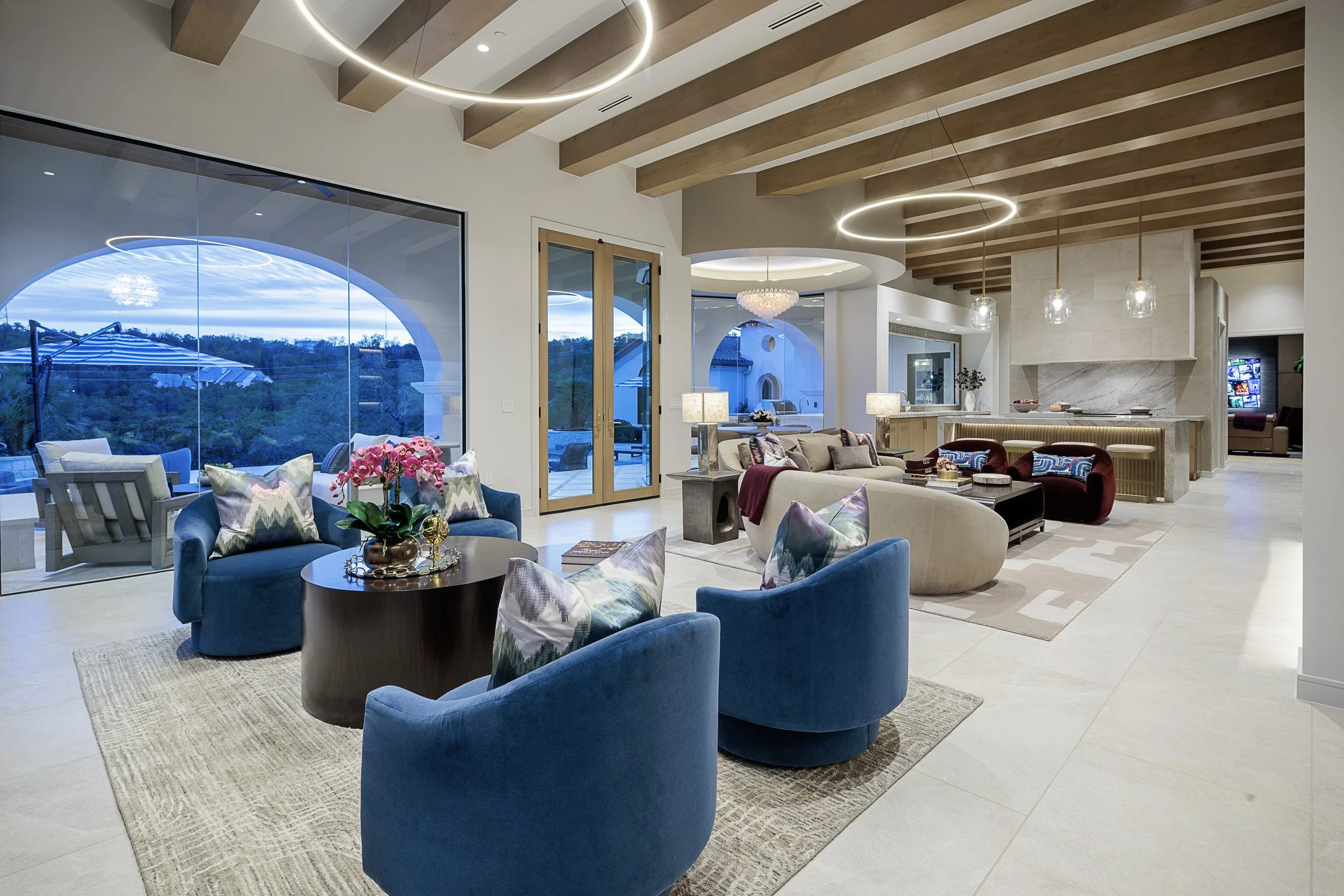
How to Choose the Right Area Rug Size, Material, and Style for a Living Room
Written by Susie Marion
An area rug is one of the largest visual elements in a living room, yet it is often selected after the furniture—or purchased quickly because the room feels unfinished.
The right rug does much more than introduce color or softness. It defines the seating area, influences circulation, improves acoustics, connects the furnishings, and establishes the room’s overall scale.
A rug that is too small can make even beautiful furniture feel disconnected. A rug that is appropriately scaled makes the entire composition feel more generous and intentional.
These are three of the questions we consider when selecting a rug as part of a complete furnishing plan.
How large should a living-room rug be?
The rug should be sized for the furniture arrangement, not simply for the dimensions of the room.
We begin with the floor plan and determine how the living room will actually function. The placement of sofas, chairs, tables, consoles, walkways, doors, and architectural features tells us what the rug needs to anchor.
In many living rooms, the rug should extend beneath all the primary seating or, at minimum, beneath the front legs of the sofa and chairs. What matters most is that the furniture reads as one deliberate grouping.
A rug may be too small when:
It sits entirely inside the coffee table area
None of the seating touches it
Chairs feel visually separated from the sofa
The exposed flooring around it appears uneven
The room looks smaller after the rug is installed
The furniture seems to float without a clear center
Whenever possible, we create the furniture plan before purchasing the rug. We confirm the intended sofa and chair dimensions, place the coffee and side tables, and evaluate the circulation around the grouping.
It is also helpful to mark the proposed rug dimensions on the floor with painter’s tape. A size that sounds generous on paper can look surprisingly small in a large custom home with tall ceilings and substantial furniture.
Standard rug sizes are useful starting points, but the room should not be forced around an arbitrary size. Some living rooms benefit from an oversized or custom rug that better relates to the architecture and furniture.
Should every piece of furniture sit on the rug?
Not necessarily. The answer depends on the room, the furniture layout, and the visual effect we are trying to achieve.
In a large or formal living room, placing the entire seating group on the rug can create a luxurious, fully resolved composition. This approach works particularly well when there is enough flooring visible around the perimeter to frame the rug.
In a smaller living room, placing the front legs of the sofa and chairs on the rug can create a cohesive grouping without covering too much of the floor.
Consistency matters. If the sofa’s front legs rest on the rug, the primary chairs should usually relate to it in a similar way. One chair fully on the rug and another floating beyond it can make the arrangement feel accidental unless the room has a clear reason for the difference.
We also consider the relationship between the rug and:
The fireplace
Built-in cabinetry
Floor outlets
Door swings
Air returns
Adjacent walkways
The dining area in an open plan
Other rugs visible from the room
Furniture that swivels, reclines, or moves frequently
A full-service interior designer in Austin can coordinate these details before the furniture and rug are ordered, rather than trying to solve the room after everything arrives.
What is the best rug material for a living room?
The best material is the one that suits the room’s level of use, desired appearance, maintenance expectations, and furniture.
There is no single material that is appropriate for every household. We ask how the room will be used before selecting the construction, fiber, color, and pile.
Important questions include:
Is this the primary family gathering space?
Are children or pets frequently in the room?
Will food or drinks be served there?
Is the room formal, casual, or both?
Does the homeowner want a plush or tailored feel?
Will chairs be moved across the rug regularly?
Is direct sunlight a concern?
How much natural variation is comfortable?
What level of maintenance feels realistic?
Is softness, durability, artistry, or easy care the priority?
Wool is often considered for living rooms because it can offer softness, depth, resilience, and a refined appearance. A hand-knotted rug can bring extraordinary character and craftsmanship to a room, while other constructions may provide a more controlled pattern, texture, or price point.
Natural fibers can introduce appealing texture but may feel firmer underfoot and may respond differently to spills or humidity. Performance fibers can be useful in heavily used spaces, although their hand, sheen, and visual depth vary widely.
The exact rug should be evaluated rather than relying solely on a material label. Fiber, weave, density, pile height, backing, pattern, and color all influence how the rug looks and performs.
Care guidance should come from the rug supplier or cleaning specialist for the specific piece being considered.
Should the rug be selected before or after the furniture?
The rug and furniture should be developed together.
At Marion Interior Design, the furnishing process begins with the floor plan, the homeowner’s existing pieces, the intended budget, and the way each room needs to function. The rug is then considered alongside upholstery, tables, window treatments, lighting, and art.
Sometimes a distinctive rug becomes the starting point for the room’s palette. In other cases, the upholstery or art leads the design and the rug provides a quieter foundation.
The order is less important than coordination.
What we try to avoid is selecting every piece independently. A sofa, rug, chair fabric, and coffee table can each be beautiful on their own and still fail to create a cohesive room.
We review rug options with the other materials whenever possible:
Upholstery fabrics
Wood and metal finishes
Flooring
Drapery fabric
Wall color or wallpaper
Stone surrounding the fireplace
Artwork
Adjacent rooms visible from the living area
This allows us to compare undertones, visual weight, pattern scale, and texture before anything is ordered.
Should area rugs match throughout the house?
They should relate, but they do not need to match.
Repeating the same rug in several rooms can feel overly uniform, particularly in a custom home where each space has a distinct purpose. We prefer to create continuity through a shared design language.
That connection might come from:
Related color families
Similar levels of formality
Repeated fibers or construction
A consistent balance of pattern and texture
Coordinated border treatments
Similar visual weight
Repeated accent colors
A deliberate progression from one room to the next
In an open floor plan, rugs are especially important because they help define individual zones without adding walls. The living-room rug may anchor the main conversation area while a nearby dining rug establishes a second function.
Those rugs should not compete. If one has a pronounced pattern, the other might use a quieter texture or more restrained design. They can be different while still feeling as though they belong in the same home.
A whole-home interior design plan helps establish that hierarchy before rugs are purchased room by room.
How do you use a rug to make a large living room feel inviting?
A large room often needs more than large furniture. It needs clearly defined places where people naturally want to gather.
A rug establishes the footprint of a conversation area. The seating, tables, and lighting can then be composed within and around that footprint.
In an especially large room, we may create more than one zone:
A principal seating group near the fireplace
A smaller conversation area near a view
A reading chair with its own table and lamp
A game table or intimate seating arrangement
A transition area between the living room and another space
Each area should have a clear purpose. Rugs can help distinguish those purposes while repeated colors, materials, and lighting keep the larger room cohesive.
Scale remains critical. A small rug in a large space can make the furniture look undersized, even when the individual pieces are substantial. A properly scaled rug gives the furniture enough visual support and makes the room feel more comfortable.
Does a living-room rug need a pad?
In most installations, we consider a suitable rug pad part of the finished plan.
The correct pad may help reduce movement, protect the flooring and rug, add cushioning, and create a more tailored installation. The appropriate type and thickness depend on the rug construction, flooring material, door clearances, furniture, and manufacturer guidance.
A pad that is too thick can affect furniture stability or create an unwanted raised edge. One that is poorly sized may be visible or cause the rug perimeter to feel uneven.
The rug supplier should confirm the recommended pad for the specific rug and flooring combination.
What rug details are easy to overlook?
The final result depends on several small decisions:
Whether the rug is centered on the room or the furniture
How the pattern aligns with the seating group
Whether a border is concealed by furniture
Where floor outlets fall
How the rug relates to a fireplace or built-ins
Whether chair legs can move comfortably
How much flooring remains visible
Whether doors clear the rug and pad
How the rug will be delivered into the home
Whether furniture must be moved for installation
For a custom or patterned rug, we may also consider pattern direction, color placement, and where important motifs will appear beneath the furniture.
Procurement and installation matter too. The rug may require receiving, inspection, storage, delivery coordination, and professional placement before the furniture is installed.
Why include the rug in a complete furnishing plan?
A rug connects nearly every furnishing decision in the room.
It relates to the furniture layout, upholstery, window treatments, art, lighting, flooring, and architecture. When it is developed as part of the entire room, it can make a large space feel intimate, give individual pieces a shared foundation, and bring the home’s colors and textures together.
At Marion Interior Design, we select, customize, procure, receive, store, and coordinate the installation of furnishings as part of the complete design vision. The goal is not simply to fill a room. It is to create a home that feels personal, comfortable, polished, and ready to enjoy.