
How Do You Style Built-In Shelves Without Making Them Look Cluttered?
Written by Susie Marion
Built-in shelves can be one of the most personal elements in a home. They provide a place for books, art, family photographs, travel finds and objects collected over many years.
They can also become visually overwhelming.
The solution is not to fill every shelf or purchase a collection of unrelated accessories. Successful shelf styling begins with the room as a whole. The objects should relate to the architecture, furniture, colors and materials while still reflecting the homeowner’s life.
At Marion Interior Design, accessories and styling are part of the complete furnishing process. We consider how the shelves will look from across the room, how individual objects relate at close range and how the composition supports the home’s larger design story.
How do you style shelves without making them look cluttered?
Begin with less than you think you need.
Empty shelves often create pressure to fill every available space. In reality, open space is one of the most important parts of the composition. It gives meaningful pieces room to be noticed and prevents the shelves from becoming a wall of visual noise.
Start by removing everything. Sort the available objects into books, artwork, photographs, sculptural objects, ceramics, boxes, natural elements and personal collections. Choose the pieces with the strongest visual or personal value. It is not necessary to display everything at once.
Place the largest or most visually substantial objects first. These establish the composition. Smaller objects should support them rather than compete for equal attention.
Should built-in shelves be symmetrical?
Symmetry can create a formal, orderly feeling, but the two sides do not have to be identical.
A perfectly mirrored arrangement may work in a traditional room or around a centered fireplace. In many interiors, asymmetrical balance feels more relaxed and collected. A tall vessel on one shelf might be balanced by a stack of books and a framed piece on the opposite side.
We look for a balanced distribution of dark and light objects, repeated colors and materials, varied heights, a mix of open and filled areas and focal points that do not compete.
How many objects should be placed on each shelf?
There is no required number. A single substantial object can be more effective than a group of small accessories. Another shelf might need a stack of books, a sculptural piece and a small framed work to feel complete.
Grouping objects can prevent small pieces from looking scattered. Odd-numbered groups can be useful, but they are not a rule that should be applied mechanically. If a shelf looks busy, remove an object before adding another one.
How do you mix books and decorative objects?
Books provide structure, color and personality. Some can stand vertically, while others can be stacked horizontally to create a platform for a smaller object.
Books do not need to be selected solely by cover color. A home should feel inhabited, and the titles can reveal the homeowner’s interests. Decorative objects should not be placed on every stack. Allow some books to remain books.
We also avoid repeating the same formula on every shelf. If each shelf contains a vertical row of books, a horizontal stack and a vase in exactly the same order, the result can feel staged rather than natural.
How can personal collections look cohesive?
A collection becomes more powerful when it is curated. Instead of dispersing similar pieces across every room, consider displaying a selected group together.
Cohesion can come from similar material, repeated color, related subject matter, comparable scale, consistent framing or a shared story. If a collection contains many small items, a tray, box, stand or designated shelf can visually contain them.
The most important pieces should have enough surrounding space to be appreciated.
Should family photographs go on built-in shelves?
Yes, but they should be incorporated thoughtfully.
A limited range of frame finishes can unify photographs from different periods. Frames do not all need to match exactly, but they should share enough in color, material or visual weight to work together.
Avoid lining every photograph across a shelf at the same height. Layer a smaller frame in front of a larger one, combine photographs with books or objects and vary the orientation.
How do you choose accessories for shelves?
Begin with what the homeowner already owns.
Travel finds, inherited objects, pottery, small artworks and favorite books give shelves a history that newly purchased accessories cannot manufacture. We evaluate those pieces first and identify where additional objects would improve scale, color or composition.
When new accessories are needed, they should fill a specific role—a tall piece for a vertical opening, a wide object for a long shelf, a darker accent, a reflective surface or a natural material to soften painted cabinetry.
Quality, scale and character matter more than quantity.
How do you style shelves around a television?
A television creates a large, dark rectangle that must be considered as part of the elevation.
Trying to disguise it with many small objects can make the surrounding shelves feel even busier. Balance its visual weight with larger pieces and areas of restraint. Repeating a few darker objects elsewhere can help the screen feel less isolated.
If the built-in is being designed during construction, cabinetry proportions, equipment, ventilation, wiring and viewing height should be coordinated before fabrication.
What makes shelf styling feel luxurious?
Luxury comes from intention and restraint—not the number or price of the objects.
Well-styled shelves contain variation in scale, material and shape while maintaining calm. Meaningful pieces are given prominence. New accessories support the homeowner’s belongings instead of replacing their personality.
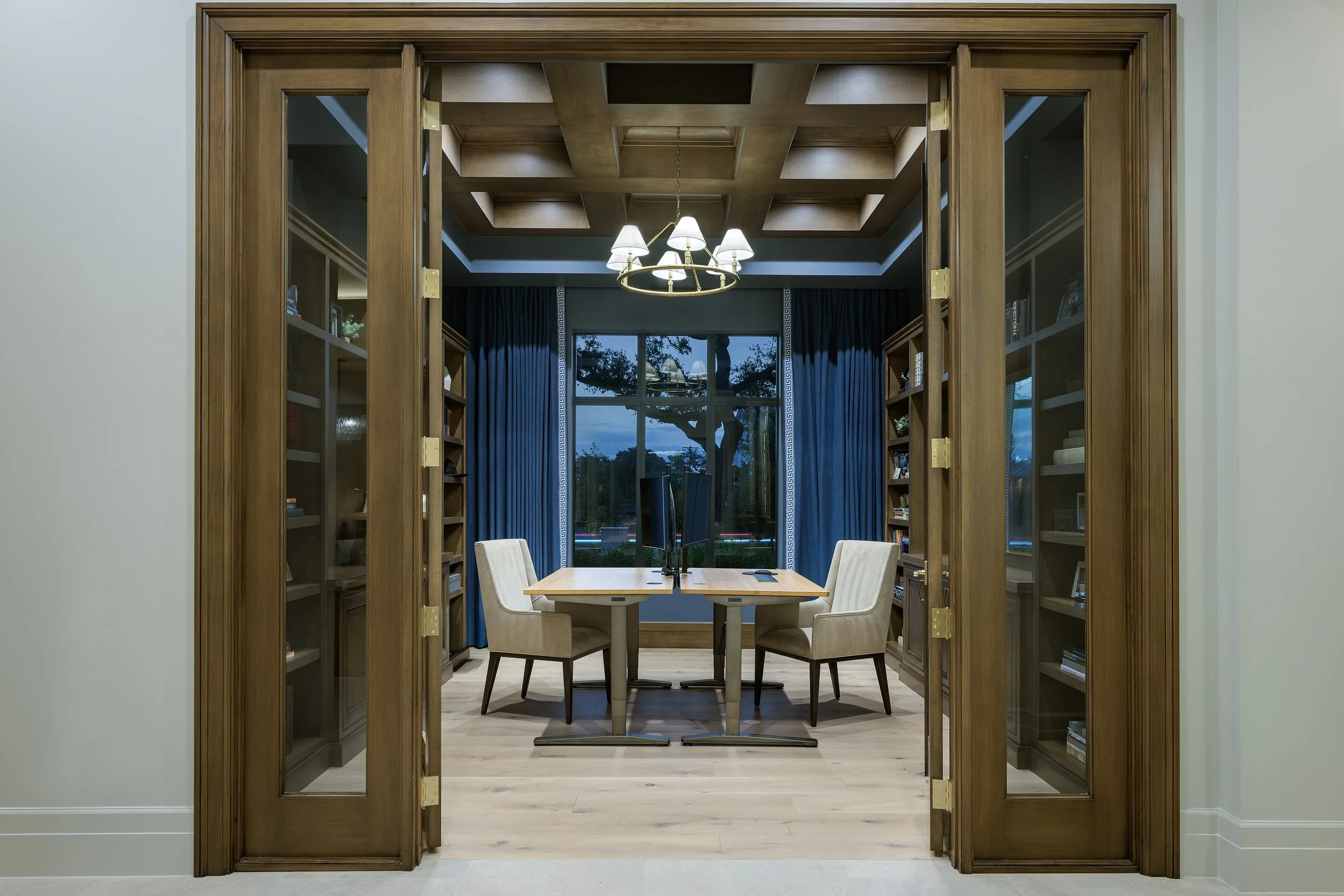
In Marion Interior Design’s Refined Classic project, the fixed finishes, cabinetry, furnishings, art and accessories were developed as one coordinated vision.
When should shelf styling happen?
Final styling occurs after the major furnishings, rugs, lighting and window treatments are installed. That does not mean shelves should be ignored until the last day. Built-in dimensions, lighting, electrical needs and significant collections should be considered much earlier.
At installation, the team can see every piece in the finished space, adjust the arrangement and evaluate the shelves from multiple viewpoints. This final editing is an important part of turnkey interior design.
Learn more about Marion Interior Design’s furnishing, procurement and installation process.
The value of professional styling
Shelf styling looks effortless when it is finished well, but it requires judgment about proportion, visual weight, color, spacing and composition.
The goal is not to create shelves that look untouched. It is to create a setting for the objects that make the home personal.
Planning the furnishings and final styling for an Austin or Central Texas home? Contact Marion Interior Design to discuss a complete furnishing and installation plan.